A "BasementHammer" approach to rules fixes, core scenario options and expanding the game, both for Warhammer Fantasy and Mordheim.
The Objective: enrich the Core Rules with more narrative and story, and add more options for even richer games.

This is our game, and we should strive to make it as good as we can.
See the "About" page for more details.

CLICK LABELS BELOW TO GO TO SPECIFIC TOPICS

Tuesday, February 20, 2018

Mordheim "The Caravan" scenario playtest (The Enemy Within)

And a new post! Getting more into a regular schedule now.
Time to delve into the crazy world of the rules for wagons! 

This scenario was originally released in Town Cryer 11, before the full rules for wagons were released. I have updated it to be in line with current rules, and added a few rules clarifications.


This is an iconic scenario for a wilderness campaign, where one warband is escorting a traveling caravan and has to protect it from a raiding warband lying in wait.
The attackers start the game hidden, which allows warbands that have invested in stealth to shine at ambushing. 


The battle can take place either in a town or in a village setting: the crucial part is that buildings can be used for cover and better positioning. Also, there are several roads along the length of the table, which cross each other and turn at given points. These are meant to restrict the wagons' movement somewhat. Why? Well... Wagons move very fast! Especially in a straight line (10+d6" if you Apply the Lash!). Even when models are standing in front of them.


This scenario is a great introduction to the wagon rules for warbands who may be considering getting one, but feel daunted by the rules. The three "wagons" in the caravan are Carts (or Treasure Carts), smaller 3-person wagons, each pulled by 2 draft animals.


Stopping the wagons from moving isn't as easy as it may look, as they can plow through a blockade. The easiest way is to go for the draft animals. Even if you don't wound, hitting them is enough to spook the beasts and potentially send the wagon Out of Control. 
Wagons have a 1 in 6 chance of going Out of Control whenever they collide with something, when the draft animals are pushed too hard by the driver or it's wheels are hit hard enough. Additionally, if draft animals are hit, it automatically goes Out of Control!
A wagon Out of Control cannot control its direction or speed, and may veer dangerously to the sides. This becomes dangerous when it collides with walls or other obstacles, suffering a S5 hit and possibly prompting further Out of Control tests.
Now, not all results on the Out of Control are a death sentence. Especially after adding the Driver skill to the NPC caravan drivers, which allows a re roll on the table.


As you can see from the rules, this scenario feeds directly into the objectives of The Seekers (who are trying to set up a trading empire) or The Smugglers (who are trying to set up a criminal empire!), as well as The Raiders in the role of attackers.
Quintessential attack on a supply caravan.


Hope this gets you curious to use wagons more in your games! They introduce a lot of fun chases in games, and are very cinematic.
Next, I'll playtest The Stagecoach scenario!

Roll high and prosper.


Monday, January 22, 2018

Castle Wittgenstein: a multiplayer scenario for 'The Enemy Within' Mordheim Campaign

And we are back to releases for "The Enemy Within" Mordheim campaign! Phew, this one took time to bake!
Hang in there, I have more coming!

Finally I've managed to finish this campaign's multiplayer set-piece battle.
'Castle Wittgenstein' pits a couple of warbands defending the castle, hired by a corrupt baroness dabbling in dark magic, from everyone else. The other warbands will be trying to either bring the baroness to justice, steal her warpstone, or just take over the castle. Whether they work together or compete from the first round onwards is up to them.

'The Enemy Within' - Castle Wittgenstein (scenario)


Castle Wittgenstein is the iconic location where the plot of 'Death on the Reik', the 3rd chapter of ' The Enemy Within' classic WFRP campaign, finally resolves and where the heroes track down the source of chaos corruption affecting the region.

Our "first-generation, not-fully-compliant-with-rules" terrain for this scenario.

In this Mordheim campaign, the lawful warbands represent the well-intentioned heroes, while any chaos warbands (or other unscrupulous/criminal types) will be defending the baroness. Of course, warbands following the 'Host of Horrors' objective (invariably Skaven) will be trying to steal the warpstone meteorite that the baroness owns, by invading the castle from the underground.


Assaulting the castle is no small feat: this is no ruined keep with holes in its walls, although one can claim that not all expenses were spared when it comes to hiring the best soldiers to defend it. The defending warbands will be outnumbered, and will have to fend off an assault coming from the outer walls, as well as preventing enemies coming in from the underground tunnels and underground dock.
On the other hand, there are several attacking warbands, each with their own objective. While they may initially cooperate to invade the castle and defeat the defenders, they will be at odds with each other as their end goals will be in direct conflict.


This will be one of the most daring siege scenarios for Mordheim: 2 sets of walls (an Outer and Inner Bailey) 2 bridges and 3 gates to punch through. This of course only fully applies to the Lawful warbands, who start the battle outside the walls of the Outer Bailey. At least part of the Rivals warband may deploy on boats and rafts adjacent to the castle's underground dock. This allows that warband to also infiltrate the underground tunnels that lead to the Inner Bailey, bypassing the gates and bridges.
It is a complex setup, and I might have to tweak it as I playtest it further.

However, the distribution of attacking warbands (some outside the walls and others infiltrating) and the fact they outnumber the defenders 2:1, serves as a balancing factor. Furthermore, defenders don't immediately rout as normal: they instead fall back to the next defensible position (from the Outer Bailey to the Bridge Tower, then to the Inner Bailey, then the Manor).


Playing 'Castle Wittgenstein' will also require some extra props beyond the castle scenery: you need some underground tiles, and a large building with at least 10 rooms ( not counting corridors).
To ensure those with a more conservative terrain collection can play the scenario, the campaign supplement will include a set of underground tiles, as well as house interior tiles. This way you can set up the Manor as simply a large building (with no actual rooms inside) and then use the tiles as warbands move inside it.


The scenario requires a good bit of preparation, as it's got several special rules. But after all, it is meant as a landmark in the campaign, with as many warbands as possible participating.
If one of the players acts as the game organizer, keeping up with the rules will be much easier, as there will be at least one person who will have the big picture in mind, and can remind other players.


Note that there is room for a lot of shady deals and unexpected role-switching when assigning roles in this scenario. Unscrupulous Sellswords in service of an Elector can momentarily join forces with the Wittgensteins for this battle if it fits their purpose. And a band of Chaos Cultists could have a fierce hatred of the Beastmen the Wittgensteins have allied with, and will thus try to storm the castle as well.

Hope you enjoy, and I appreciate any feedback you can throw my way (which it will probably need!).

Roll high and prosper.


Thursday, December 14, 2017

Narrative rules in Age of Sigmar: a review

This is a post a long time coming, and I've been doing my research the past months making sure I got the full scope. And tried my hands at a few games.
This is for newcomers to Age of Sigmar, current players, naysayers and even those who aren't interest in this edition of the game. There are ideas here that are very valuable and relevant, and many games could benefit from it.
  •  For those still waiting for "The Enemy Within" Mordheim scenarios, I'm still editing them! Evidence:
 Now back to our topic of today.
Age of Sigmar has currently LOTS of easy-to-fit, modular rules that are filling up all the narrative needs you can have. They have slowly been building up since last year.
I'm surprised at how I myself am so satisfied.
For the uninitiated in Age of Sigmar (AoS), one of the biggest perceived flaws of the system was a lack of larger game structure and unit customization, especially in terms of magic items and certain upgrades, with the biggest offenders being Hero models (which had become painfully generic). This led to a huge fear that AoS would not cater to narrative-led games but more to casual light play.
Then things started to change, massively, especially with The General's Handbooks. But I will go by parts.

BATTLEPLANS (aka scenarios)

The earliest change you could see, even in the first releases, were Battleplans, or scenarios. In AoS, many of them were released in the first campaign books, and these were very diverse in their objective, and already set out the blueprint for narrative missions.
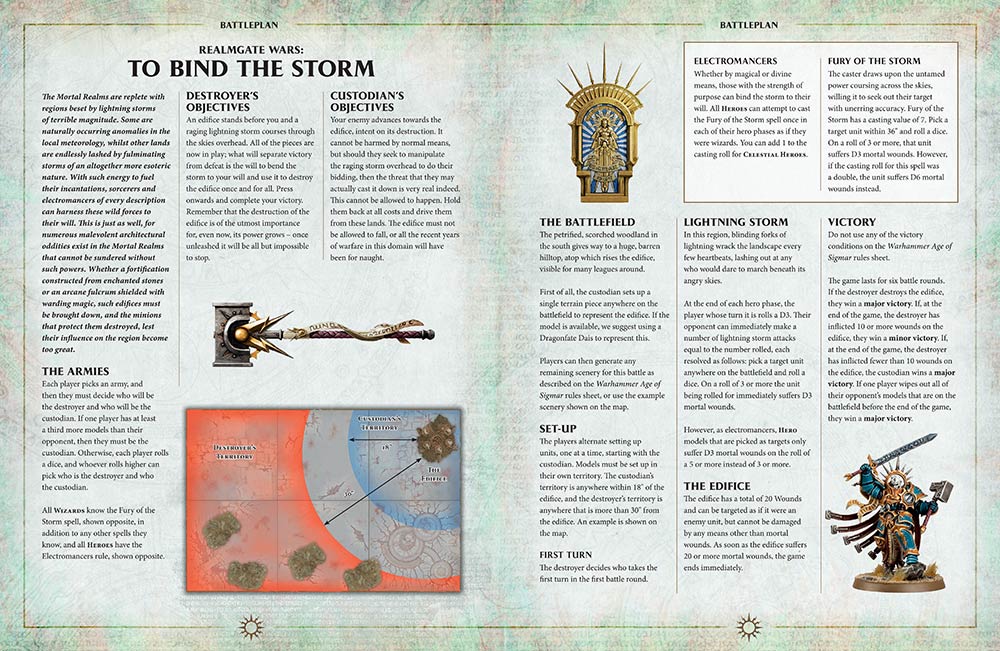
From the onset, they were as rich or richer than scenarios you would find in the old 6th ed Generals Compendium or the narrative scenarios in the final section of the 8th ed Core Rulebook. With the first Generals Handbook (2016), most universal narrative scenarios were covered: flanking attacks, defensive blockades, King of the Hill, last stands, etc. They even have a strategy matrix scenario, where both players' pre-game strategy decisions affect the game setup.
Being released as part of the game's core functionality, instead of "those other scenarios that look funky", went a long way to normalize their use.

TIME OF WAR

These are modular special rules, that represent different environments, or battle set ups: imagine battles supported by divine magic, or access to new spells drawn from the local place. For example, all wizards when in the Realm of Fire gain access to the Fireball spell.
The rules are short, contained, and easy to paste onto any battleplan. And are perfect to layer onto any game to represent fighting in different terrains (or planes of existence, as we now have in AoS).
But (and this is the best part), in a very sneaky way, they have introduced RPG-like item upgrades into Age of Sigmar, to develop your army! :O If a player wins a Major Victory in a battle, they get to collect a Triumph from that region's Time of War rules. These take the form of small magical items or magical blessings, such as the return of the Ruby Ring of Ruin or the Acorn of Ages, or a Wizard gaining a Tome of Fire which grants them the use of the Fireball spell outside the Realm of Fire.
As per the rules Triumphs only apply to the next battle, but within any gaming group you can house-rule it that Triumphs (or some of them) are permanent.

ALLEGIANCE ABILITIES

This was one of the biggest splashes coming out of the Generals' Handbooks, and what really started to introduce customization back into the game.

- Flavorful Abilities
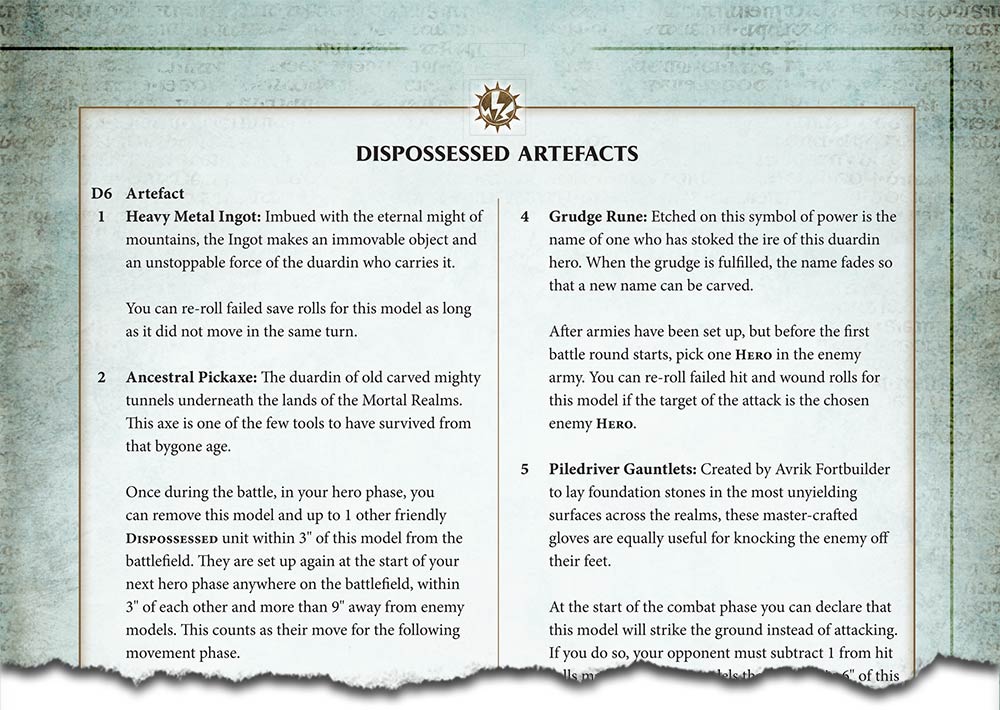
They give specific battle traits rules  to armies from specific grand alliances (Order, Chaos, Death and Destruction) that really evoke the narrative spirit of their models. They give command traits to your general, from which there are a few choices, and help to define their powers and personality. Finally, you can give Heroes magic items (though in a much more limited manner than previous editions) which bring back many favorites.
 While having less options and less customizability than previous editions, the fact that points are not involved, and you just pick an option from each list, it makes army-building less time consuming and avoids number-crunching.
 With the Generals Handbook 2017 most allegiances (like Followers of Tzeench, Ghostly Undead, or Duardin Fyreslayers) also got their own set of abilities and further expands the flavour of that sub-faction (like Wood Aelf Wanderers being adept at mist-walking and shooting on the run).

-Magic Lores
Finally, and this has only been explored in a couple sub-factions, we are starting to see specific Magic Lores being re-introduced. Sylvaneth, Bonesplittaz and Followers of Tzeench wizards can each get one single spell from the Lore list, on top of those they know, as long as their army is aligned to that specific allegiance. They still cannot cast more spells per round than before, so balance is preserved.
And just like that, a lot of flavour gets reintroduced back into the game almost seamlessly.

OPEN WAR CARDS

This one is probably one of the best ideas ever in Warhammer, and previous editions would have benefited massively from this gaming aid.
It is a scenario and special rules generator in the form of a set of cards, with a pile for Deployment Zones, Objectives and Scenario Special Rules. It also has a pile for Ruses (special tricks players can play on each other during battle) and Sudden Death (special victory conditions for armies that are significantly smaller.
And just like that, you can generate an interesting random scenario, with diverse objectives from capturing objectives to killing a messenger.


Further, you can combine specific cards from each pile beforehand to build custom scenarios at your pleasure. And also, Ruse cards make a great bonus resource for use in narrative campaigns.


CAMPAIGNS

We had been waiting for these for quite some time. Boy, they really spent time streamlining these. They are very easy to implement, but they really REALLY shine when you connect them to the other narrative rules options, more than any other Warhammer edition before.
-Army progression campaigns
The first form these take, and the most straightforward, is a Time of War rule called Regiments of Renown (you might remember this name ;) ) that allows each unit to gain a 'veteran' ability after each game. This is great for league and ladder campaigns in a gaming group, especially when players still have small armies.
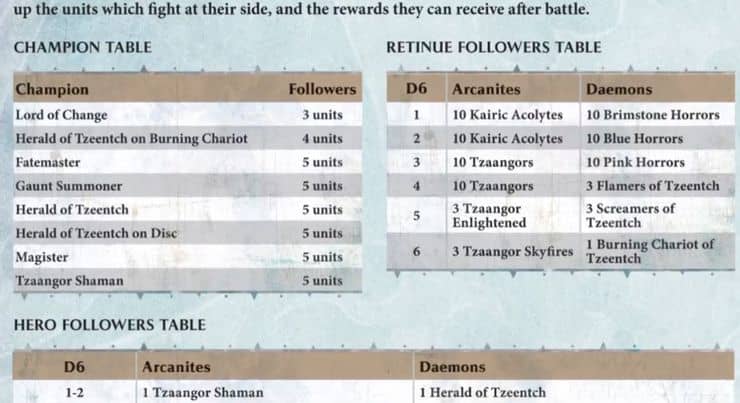
The next big breakthrough was Path to Glory, which was so popular that it got released and expanded in its own book. In this format, you pick from one of many allegiances within each Grand Alliance (like Khorne Bloodwarriors or Sylvaneth) and choose a champion and a few units of followers. After each battle and accruing glory points, the army is upgraded with either more followers or champion/unit 'veteran' abilities which all build on the army's flavour (like undead units recovering more models, or Aelf champions improving their command abilities). The follower tables balance the strength of the added models by how many you get to add in each upgrade.
This is the next easiest step to implement in a gaming group, and pick either a glory points threshold to win or come up with a special battle royale final scenario or somesuch.
Of course, players can use either of these progression rules (or both!) bolted on to a larger map-based campaigns.
-Map-based
The Generals Handbooks introduced a few simple setups for map campaigns, which are pretty easy to mock up in gaming groups.
But things really took off with the release of Firestorm. This is a boxed game, and just feels like a boardgame: a map, cards for resources and point tracking, and reusable sticker/tokens to track army position and garrisons built.
It is designed to be very freeform, where players can challenge for control of any map section anywhere, but as they build garrisons they are granted more troops when fighting nearby. And rivers restrict this, so geography still plays a role. Also, the scale of the armies fielded is also freeform, and players can agree on any value (of matched play points or even skirmish-level renown points) to fight their battles, and even vary it from battle to battle.
As players fight battles, they gain Glory and Build points. The first count towards final victory, while the latter are used to build garrisons and upgrade their deck which determines how powerful their overall force in the campaign is. It is from this deck that the amount of points they can field is decided.
 Each map region has its own Time of War rules to ensure different areas remain interesting and distinct to fight in.
The story in Firestorm is actually one of its coolest selling points, which strangely is not being used in promotional material. The reason armies are fighting there is to gain control of the Prismatikon, an ancient arcane array (from a fallen civilization, of course) that harnesses the energy of a captive elemental fire-entity into a beam weapon. Together with the arcane computer of the Infinity Gears, this magical weapon of mass destruction can be fired through portals across the Realms to level entire cities. Hot dang!

NARRATIVE GAMING EVENTS

Finally, we get to what is probably the biggest change in Warhammer narrative gaming. People are organizing lots of Narrative Events throughout the world. They are like tournaments, but unlike player's competing with each other as gamers, players compete as allegiances and drive forward a narrative played out in flavorful scenarios. Lots of campaign and scenario special rules are being created by avid gamers and organizers out there.

You can find the latest news in the Narrative Event Organizers Network.
If only they had done this back in 8th edition Warhammer. Now, not only are they popping up everywhere but even Games Workshop is supporting and popularizing these events. Wow. :)


THE NARRATIVE SETTING ITSELF
Coming to the end of the article, I'll just describe what people who aren't familiar can expect of the Age of Sigmar world, and to understand how life in the Mortal Realms really is for the average mortal there. The setting of Age of Sigmar has often been touted as shallow and designed in a rush, but in truth I believe Games Workshop should really talk about it more, so that people understand its stories and how people see their world.

The Old World of Warhammer was destroyed. This was many millenia ago in the Age of Sigmar. People talk about it in a mythological way, and how the gods (Sigmar, Nagash, Allariele) and other powerful supernatural entities (Arkhan the Black, The Glottkin) trace their past to that place. But the origin of many of these larger-than-life characters is now shrouded in myth (only we know the truth!).
These gods helped populate the Mortal Realms: eight planes of existence each of which is dominated by a prevailing magical force (Aqshy the Realm of Fire, Chamon the Realm of Metal) which corresponds to one of the Old World's winds of magic. This was apparently how the remnants of the Old World stabilized: they are now fantastical and highly supernatural. Realmgates, mystical natural portals between the realms (or within the same realm) that can take many shapes, connect them and allow travel and trade. Warhammer is now Cosmic Fantasy, much like Planescape.
 
Each god took stewardship of a different realm, and helped the mortal survivors who managed to start eking out an existence in these Realms, using the realms' resources and slowly incorporating them into their culture. And multiple cultures and races (aelfs, duardin, humans) started cooperating and practicing multiple religions in the same place (including Nagashian worship!). Many cultures across the Realms evolved, and empires already rose and fell. But what really drove all the civilizations into the ground was the massive invasions of the Age of Chaos. Not the usual raids, but a concerted invasion that broke the gods' power.

Now most mortals are either enslaved, converted to Chaos or are valiantly resisting in guerilla fights and hiding out in resilient locations. This has now been several centuries of Chaos domination.
This is where the Age of Sigmar starts, with Sigmar's warriors, the Stormcast Eternals, returning to bring freedom to the Realms. They even find settlements of survivors who have never stopped believing in Sigmar after all these centuries and prayed to him for salvation.
And the Stormcast themselves are former mortal heroes who have been reincarnated as Azyr-empowered superhumans, and can be reincarnated again and again... but at a cost to their souls and memories. I want to see how long will it take for some Stormcast to start rebelling against Sigmar's decision in enlisting them and forcing them to fight forever.

At this point in the story several regions have been liberated and small cities have sprung up from the survivors and migrants from Sigmar's realm... This also works well as a "points of light" system for RPGs, making it easy for "heroes" to adventure out of the safety of the city to the wilderness and fight monsters.
 While the tone of the Age of Sigmar is heroic and its Stormcast always shown in a valiant light, reading between the lines you can see how dark seeds of doubt are being sprinkled, that can be used in future stories... The people of the cities who migrated from Azyr behave as if they are better than their "uncivilized" neighbours from the liberated realms. People are wary of the Stormcast, these superhuman war-obssessed angels who arrive in thunderbolts from the sky, and who might quickly go paranoid if they suspect Chaos corruption. In the larger plan of Sigmar, risks cannot be taken.

So things are looking up on the narrative side, much to my surprise. It's just that Games Workshop could be promoting it more, other than the books. They are starting to, here.
All the details that 'sell' the narrative are under the surface.


And that's it. For now.
I am very surprised that, after such an absence of investment in narrative gaming from GW for several years, they have come back so strong and effective.
And I have learned a lot in terms of game rules structure, and deliver simple, modular but effective rules.

Roll high and prosper!

Monday, August 28, 2017

'The Undertown' scenario playtesting and Campaign Rules (The Enemy Within)

Here I release another new scenario for "The Enemy Within", and discuss some of the issues in playing and optimizing scenarios with random tile placement. I also release the Campaign special rules for "The Enemy Within", including warriors under arrest and Convictions, capturing hostages, succumbing to the lure of Chaos, and what kind of loot you can find inside Imperial Cargo.


While I was still re-writing the 'Castle Wittgenstein' scenario (as promised), we had a reunion with our friends from our Edinburgh Gaming Group, staying at a lakeside cabin in Minnesota. Fishing, marshmellows by the campfire and of course, wargaming.
We hadn't played together in more than a year, so we couldn't let the opportunity pass.


'The Undertown' scenario (click to download):
This scenario is very much based on Werekin's 'Burrow Town Collapsing' scenario from 'Mutiny in Marienburg', and follow most of the guidelines and standards he set there.
I also drew from some of the original work done on Mordheim sewer scenarios, by Christian Elegaard in Town Cryer, adding rules for navigating slippery sludge and rickety sewer planks, which I felt were missing, as well as an added fear effect that can get models running in the dark.

The Undertown pits the warbands stalking each other while they navigate the sewers and catacombs under the cities of the Empire.

New stuff in this underground scenario:
The Undertown focuses mostly in the defending warband (the one who picked the scenario) trying to find a special Hidden Room, which will be different depending on what type of warband it is and what they are trying to achieve. This can be a warpstone deposit, an illegal congregation to Chaos, a Traitor contact with secret info and contraband, or even the keep's dungeon to spring their comrades out of solitary confinement. The last tile will always be this Hidden Room, if someone hasn't found it yet.

Along the way, they can find random rooms with some loot, like a well to the surface, a crypt, or an abandoned cellar. Bodysnatcher warbands can have their fill raiding those crypts in search of fresh corpses and heirlooms.

For attacking warbands, there is also something to be gained other than just pursuing the defending warband: arresting the Traitor or burning down the Chaos shrine earns Campaign Points to warbands following particular Objectives. They can also stumble upon other special rooms by chance, just by Exploring new tiles.

As in 'Burrow Town Collapsing', there are random Subterranean Events, which include the deadly infamous traps and wandering monsters and denizens of the tunnels. Both of these were the target of a bit of tweaking, for reasons that will be explained below.

Re-balancing in random-tile scenarios:
There were a number of things we felt needed addressing. We have played 'Burrow Town Collapsing' quite a few times now, mostly without too many problems. However, there were a few things we felt needed addressing.

Random tile generation mostly works well, but its not uncommon that a warband finds themselves surrounded by dead-ends at some point. Of course, there is the "Heroes search for the secret door" mechanic, which solves this problem, but in the case of some warbands (especially low-Initiative warbands) this can take 1-3 rounds. And often this occurs near the beginning of the game, so some warbands remain isolated from everyone else for a large part of the battle.
For the sake of "The Rule of Fun", we felt that we needed to reduce the chance of this happening, so I reorganized the 'Unexplored Tiles' table to increase the probability of generating T-junctions instead of more turns and corridors. More access to the table is always good, players get to move around better, and the game moves along faster.

I also added an Aqueduct tile (represented as a narrow bridge across the tile), which has the same rules as the Aqueduct event in Burrow Town Collapsing (if you fall on the water you are washed into another random tile).


Subterranean Events I find are very interesting, but two things stood out as being a bit too distracting from the game. These are Traps and the Rats & Spiders. Oh my sweet gods, the rats.
Let's go by parts.

The Traps in these underground scenarios come from the Khemri ruleset, and I love their originality. However, it is clear that some traps are far, FAR deadlier than others. Particularly the Sandbox trap. But their order on the table makes some of the deadlier traps have a higher probability to appear than others, which doesn't make much sense. Sandbox can kill an entire warband in one go, through no fault of the player. I know this is Mordheim and it is supposed to be deadly, but I felt some re-ordering of the table was needed.
Another trap-like event, which was a very big offender, was the Mold (the sleep-inducing fungus). This is the one that Stuns models if they fail a Toughness test. Is an interesting trap, but it happened far too often and delayed the game far too much. I placed it in the table as the lowest probability event to occur.

Now for the animals. The rats were just everywhere, all the time. So many Giant Rats. Warbands spent more time fighting them instead of each other. We first reduced the  number that appear, then I decided to move them to the Tunnel Dwellers Subterranean Event result. I kept a "swarm of rats" event result, which just deals damage but then goes away, to still feature rats often (its the sewer after all), but it keeps things moving much better.
And the spiders, oh the spiders. Warriors getting caught in webs everywhere, dwarves and zombies failing their Initiative tests to escape, and us watching our gaming time being occupied with meaningless combats. It happened too often in the Events. I removed the Spiders altogether, and kept them for a more cave-based scenario.


To finish, I padded out the Subterranean Events table results with slippery floors and rotten planks, which add a bit more variety but don't delay the game as much, and present the players with an interesting challenge yet one that is easier to plan around. I also introduced the 'Spooked!' result, which scares D6 warriors (dripping water, noise in the corner, feeling something crawl up their leg, etc) who have to test for Fear or run away screaming. Of course, Skaven, Dwarves and Night Goblins get a bonus as they are used to these tunnel conditions.
This helps make a trip  underground in the dark a scarier prospect, and make those Ld scores on every model count!

Tunnel Dwellers: I changed the table for random monsters in this scenario, to make sure that cultists and mutants show up (it wouldn't be The Enemy Within if they didn't!). There is also a chance that Sewer Jacks show up, who will team up with Lawful warbands and fight against smugglers and evil warbands, so it's not all bad news.


Campaign Special Rules (click to Download):
Here are the special rules that apply when running The Enemy Within campaigns. These may evolve a bit more still, as I start now to connect all the working parts of the ruleset to ensure they all run smoothly.

Putting warriors under arrest works like in Mutiny in Marienburg, but the Conviction chart roll is modified by having worse results if the model is a Chaos worshipper, a Criminal or carrying drugs or illegal items.

This campaign requires that players assign Alignments to warbands, which will determine what roles they play in many scenarios. Lawful warbands will always be the ones protecting civilians, while Evil warbands will always be the ones attacking them, and so forth. Nonetheless, there are Objectives that allow many warbands to remain Neutral in alignment, and still have some flexibility in their roles.

There are also expanded rules for taking hostages during battles, and what options are available to each warband if they acquired captives during battle or Exploration. Because this campaign makes use of structures built within encampments, using captives as slave labour (Prisoners of War) can speed up construction and free up henchmen to join the battles.

Trade rules are the same as laid out in Mutiny in Marienburg, but more scenarios in this campaign make use of Information Points. These allow the warband that earns them during a game turn to be able to choose their next scenario, gain Campaign Points or unlock special scenarios.

The rulesheet also reprints the 'Eye of the Gods' and 'Marks of the Dark Gods' rules, which allow any Chaos warband to have access to Marks of Chaos, and earn mutations when they advance.
New to this campaign setting is Heretic Converts: whenever your warband has too many models with mutations, carrying magical wyrdstone shards or illegal spellbooks, you may have to start rolling to see if Chaos seduces them. If they do, they will stage a coup within the warband, and install a new leader that can promote the glory of Chaos (and possibly forcing the warband to change Objective).

The Fantasy Flight Games center outside Minneapolis.
What a humongous gaming space. With a full bar as well!


This is all for now, folks. 
I hope to get the Castle Wittgenstein scenario up sooner than this (its been quite a while since my last post!).

Until then, roll high and prosper!


Tuesday, June 20, 2017

Mordheim demo @ Devir Arena, Lisbon, Portugal

This time, I decided to bring some Mordheim to my own country. Plant the seed, to get people interested.
So I went for 2 weeks holidays back home, and called up the bigger local gaming store to see if they had place for us to play.

And boy, was I surprised: the place had SO much space and gaming tables, full of beautifully painted terrain. I was used to it in the gaming shops of the UK, but none of this really existed in Portugal while I was growing up. It was very niche (even amongst gamers).
Portuguese gamers, rejoice, and head to your local store for games! 😃 They got the space!


I ran a simplified version of Mordheim, where each player only controlled a Hero and two henchmen, all pre-generated with weapons and equipment.
Very fast-paced and simple to use, and thankfully I had many models available for players to pick among several types of warband.
It's all in the preparation, people!
We played a simple King-of-the-Hill scenario, with the players trying to take control of the portal in the center of the table.
We had a Dwarf Treasure Hunters warband, a Wood Elves warband, and a Cult of the Possessed warband playing.

It was a small affair (mostly because it was announced on such short notice!) but it gave me an idea of how much tabletop strategy and skirmish gaming is starting to take hold back home.
It is really growing.
This speaks a lot to a Games Master's ability to round up gaming groups of interested players, as it does require some groundwork and a network of gamer friends. You need to be patient and work on it, playing and talking with people and raising awareness for a year or so, before one can start launching new initiatives. And advertising is important! (see end of post)
This worked well in the Edinburgh gaming scene (having spent 3 years as a RPG GM and 2 years as a Mordheim organizer). But then again, the UK is more of a fertile ground for gamers (many have been playing for decades), and many gaming venues already existed, or opened in the last years.

 Age of Sigmar is apparently attracting new players in Portugal, if only because of their discounted starter boxes and ability to start playing with few models.
Which is exactly what GW *DID NOT* do for the longest time, where they could have supported low-model gaming modes, such as Mordheim, Warhammer Skirmish and warbands.

Now Age of Sigmar is really exploring all those ideas, and literally asking players to set up their own campaigns and house rules. I have to tip my hat off to the gentlemen (and madams) in charge of this shift in company policy. :)
See here and here what they have been fostering in the Community.

This is a great step forward in bringing the narrative side of the game to major events full of enthusiastic players. And a recognition for the role of Campaign Masters and organizers in tabletop strategy games, beyond the tournament setting.
We would like to thank Carlos Almeida, from Especulatorio magazine, for coming and trying out some Mordheim with us.
Especulatorio is a monthly portuguese e-magazine, which covers all major news, talks, local events and development within the geek gaming, movie and literature industry.
The group also organizes community gaming events, and fosters debate about gaming trends and the future of geek interests.


Mordheim advert - stick it on the wall of your gaming store!
Just replace the "Warhammer Narratives" logo on the bottom with your own gaming group's logo and rules link, and you are good to go!

Roll high and prosper!