A "BasementHammer" approach to rules fixes, core scenario options and expanding the game, both for Warhammer Fantasy and Mordheim.
The Objective: enrich the Core Rules with more narrative and story, and add more options for even richer games.

This is our game, and we should strive to make it as good as we can.
See the "About" page for more details.

CLICK LABELS BELOW TO GO TO SPECIFIC TOPICS

Wednesday, March 22, 2017

The Evacuation - Scenario playtesting (The Enemy Within campaign)

We have playtested a few scenarios a while ago, which led to a bit of a rewrite of some rules.
Here is how it played out.

"The Evacuation" is a scenario designed to feature a massive town raid, with an alliance of 2 evil warbands literaly smashing and burning property and slaughering people. Against them are pitted 2 good (or at least civilized) warbands, who rush in to evacuate the last remaining refugees running from the onslaught. 
An additional plot in the scenario is that among the refugees hiding is the local Count's son and his bodyguards.
There should be 6 proper buildings on the table, which is where the refugees may be hiding: warbands will have to break in and search. There is a 1/3 chance of refugees being there, otherwise it is empty or it may hold some goods (in the form of a cargo crate).
Victory is determined by how many refugees are saved (by the defenders) or captured/killed (by the attackers or stuck inside burning/collapsed buildings), worth 1 point each at the end of the battle. Rescuing the Count's son (or capturing/killing him) grants 3 points instead of only 1. 
In addition, attackers also gain 1 point for each house destroyed or still burning at the end of the battle. To balance this, D3 refugees are placed in the center of the table at the beginning, who can be rescued quickly by defenders.
Normal routing rules are also in place, but a warband that scores more points can still win even if they rout.

Because we had limited space and only 2 players, we decided to just make a 1vs1 game, to see if at least all the rules were working well.

Each of the attacking models carried a free torch, so they could more easily set buildings on fire.


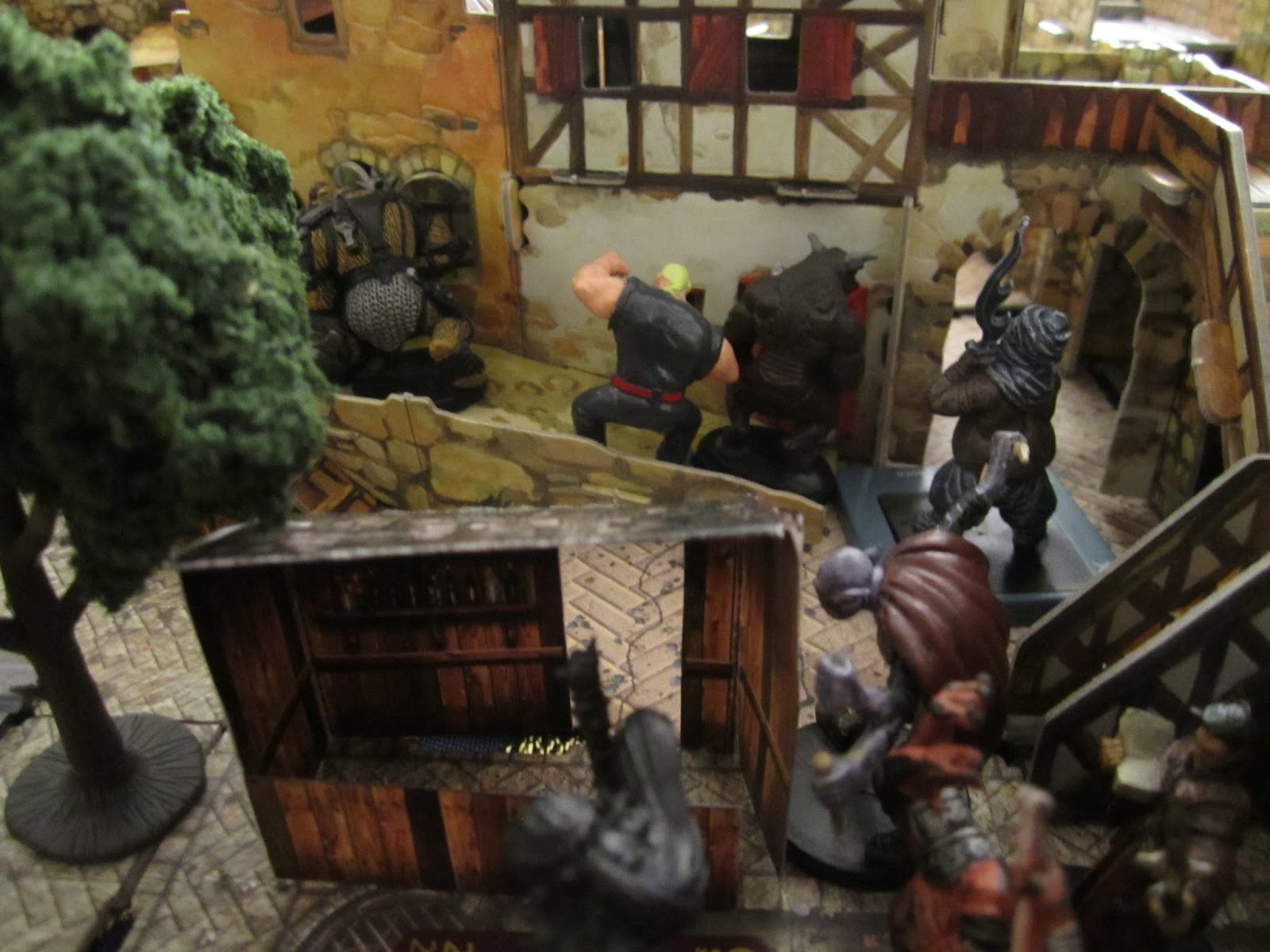
A Chaos Magister surveys the town for victims.
An elven Waywatcher infiltrates the town

Possessed invade the central square.

Beastmen and Cultists are busy tearing doors down and setting fire to buildings.


 Well, we found out that the refugees are terribly more trouble than we thought. Their behaviour is to run off, away from the closest warband model, if someone approaches too close. However, when models broke into their houses, before they had a chance to step inside (because they cant take any more actions that turn), the refugees would scurry out the windows! Windows and doors are considered unlocked for those inside, and indeed they were running from the closest threat! But it devolved a bit into a slight Benny Hill chase scene... (which is not totally out of place for this game, truth be told...).
To fix this, the refugees can no longer escape thru locked doors and windows, even from the inside: they are panicking and freaking out, because a murderous barbarian or some monster or other just barged into their house!!
Refugees escape through the back window of a burning building.
A Mutant corners a helpless villager.

A terrified villager tries to jump down a first-floor window, only to land badly and go Out of Action.


Another rules quirk relates to the "Fire rules" consolidated in Border Town Burning. The rules ask to roll at every player's turn to see if the fire worsens. In effect, what this caused was that as soon as a house caught fire, it was a foregone conclusion that it was lost: woe to the model that didn't get out immediately! They burned down too quickly.
We now adjusted it so you should only roll once every game round (after all players had gone).

A Waywatcher finds the Count's son and his retinue.
Elf warriors escort the remaining refugees out of the town.
Regarding the objectives, we found that the balance between the attacker/defender roles, of finding refugees they can save or capture/kill, was not exactly a straightfoward one to measure. Attackers can simply set everything on fire, one building after the other, much more quickly than defenders find and save refugees. However, once defender do find them they immediately gain control over them, while attackers need to chase them down. Also, each house that is empty is only worth 1 point (same as 1 refugee) for the attacker. So this forces attackers to press onto the defenders turf, to ensure they strike at any refugees they may find. It has been a good exercise on designing scenarios with asymmetric objectives.
We found that in the end things balanced out, but a few surprises may still be in store. If you try it out, feedback will be more than welcome.

Updated scenario rules: "The Evacuation v.1-2"

Next, the playtesting for "Death on the Reik" scenario! And an update on Mordheim Boat rules!

Saturday, January 28, 2017

Mordheim - 'The Enemy Within': new objectives

My apologies for the slow releases... it takes some time to partition time away from work these days, and get everything from scribbles of rules to a formatted page. Here are three new Objectives for 'The Enemy Within'.


The third of the 'evil warbands'  objectives, "The Cabal" lets warbands with spellcasters to run an underground cult of lore-seekers and researchers of the dark arts. The path is available to both Chaos-worshipping Human warbands as well as undead. The objective is to amass arcane items and magical grimoires, with a steady stream of sacrifices.
Progression along this objective is mainly achieved through acquisition of items (either as loot, purchased or located during visits to Locations). There is less emphasis on winning certain scenarios to gain Campaign Points (although the required items can be found in some specific scenarios).
Ultimately, the warband's final ritual will require the sacrifice of 6 priests, which they must secure beforehand. Their goal is to unleash a ritual to forever change the face of the province, with them as it's masters.


"The Wardens" are the countryside law enforcement: Roadwardens, Riverwardens, local constables and militias officially sanctioned by the local rulers. Similar to the "Guarding of the Peace" Objective in Mutiny in Marienburg, this warband's objective is to arrest criminals (especially ringleaders), track down and uncover the hideouts of felons and cutthroats, as well as expose plots that fuel Enmity between Imperial provinces.
This promotes the warband to invest in the Exploration phase (to find enemy encampments), as well as take the fight to criminals and savage warbands, so they can arrest as many Heroes as possible, with extra rewards granted for captured Leaders. Importantly, their investigations allow them to share the location of enemy encampments to allies. Finally, "The Wardens" earn rewards for playing scenarios that allow them to remove Enmity between Factions, as they unmask plots that have kept the tension rising.
Accomplished warbands following this objective will be able to strip legal immunity from certain Heroes, and can call on Roadwarden reinforcements as well as requisition transport from the local authorities.


"The Sellswords" is a military progression Objective. Their goal is to successfully defend or attack military outposts, take out enemy Leaders, propel their commander to success and raze the strongholds of invading warbands. 
You can see how this objective synergizes very well with "The Wardens' " ability to find enemy encampments. This type of objective also promotes the warband's investment in their own encampment: the more they build up their base of operations, the more their reputations rises. They are also able to expand their warband's maximum size and get free recruits when they suffer casualties fighting certain enemies.
Eventually, the warband will be granted its own estate to build up their stronghold (and the Leader can claim the title of Baron). To win the campaign, the warband must fight the most powerful group in the campaign, and not only force them out of their encampment but meet them in the fields of battle. This is where both warbands will expend their resources and influence to amass a small army and decide each other's fate once and for all.

Some extra work may still be required on these Objectives, and I would like to make sure each of their 'Campaign Win' scenarios be memorable events. Keep an eye out as I release more material.
Still have 'The Raiders', 'The Seekers' and 'The Zealots' to publish.

Roll high and prosper.


Tuesday, December 27, 2016

Mordheim Roleplay part 4 - Personality and Social Exchanges

Finally, after more than a year, I finally got this out. It has been sitting on my hard drive half-finished for too long.
The Gods bless Yuletide and giving us peasants a break from work, so I can have more time to write rules :)


Previous Mordheim RPG posts:
Post: Intro and analysis
Post: Basic Rules
Post: summary of possible Careers and their special rules (work in progress)

Well met, folks, and I'm happy to show you this so you can hopefully put it to use.
This Part 2 or Mordheim Roleplay rules presents players and GMs the ability to turn the Leadership characteristic (a very one-dimensional representation of a character's mental ability) into a series of mental characteristics. The diverse combination of mental characteristics defines the personality of the character, and GMs will be able to use them as a vehicle for storytelling, and also as a roleplay challenge for players.

Mordheim Roleplay part 2 - Personality and Social Interactions (click to download)

In true Mordheim style, who wouldn't wish to see a party of adventurers trying to hold their Dwarf Slayer back from a fight with the Count's guards, and the player controlling the Slayer (who also DOESN'T want to fight the guards!) miserably fails its Self-Control test and all hell breaks loose.

There are seven Mental characteristics that make up a character's personality:
Generosity, Forgiveness, Humility, Self-Control, Free-Spirit, Logic, Willpower.

Personality tests are taken whenever a character would presumably do or say something against their personality. They are 2D6 characteristics tests against the Mental characteristic in question (much like a Leadership test). If the player fails the roll, they cannot help but act according to the character's personality.

Social Exchanges: The rules also show how engage in arguments with NPCs, where players use arguments in order to test the NPC's Mental characteristic most likely to give them a positive result. Depending on the arguments, the Mental characteristic they target and the NPC own Personality, the GM may allow bonuses or penalties. This encourages players to engage in roleplay and real argumentation, which itself feeds the game mechanics.

It should be noted that generating the Personality of a character is something that a players must be comfortable with: this system is meant as a guideline and a roleplay challenge, and no player should be stuck playing a character with a personality they don't enjoy.
I hope you enjoy it, and it can be of use after spending so long in the making.
I certainly cannot claim to have truly come up with this system myself, as it was heavily influenced by the Pendragon Roleplaying Game's Personality system. But to my mind I believe it is a good addition to Mordheim RPG, as it puts fate (once more) in the hands of the dice, much to of the dismay of the players, but also helps brings the characters to life. This has the added benefit of allowing beginners to the roleplay genre to take cues on how to act their character from the Mental characteristics it possesses.

NEXT: expanded Skill lists for different Careers (bussiness skills, social skills, exploration skills, etc).

Roll high and prosper!

Wednesday, November 23, 2016

'The Enemy Within' narrative campaign - new Objectives!

Hello folks!! 
My job has sucked me down a (metaphorical) hole for the past months, so my game-design time has been limited to scrawling on my notebook during my commute! I've also been working on something else Mordheim-related... hehe Soon to be posted.
But today I'm bringing out finally more material for The Enemy Within. A lot of other material is almost ready as well, but I still have to spit-shine it and make it nice before upload.

Warband Plots - The Power Behind the Throne & The Host of Horrors (click to download)

These are actually some of the more complicated Objectives, especially "Power Behind the Throne". This Plot shines when there are at least 2 other warbands that are part of the Factions of the Empire (ie. not savage or chaotic warbands). They thrive on manipulation of the other warbands, and with their ability to bail any model our of jail through bribery the other warbands will soon be in their debt. The more non-savage warbands there are, the more leverage this warband gains (as more warbands suffer from being thrown in jail).

"The Host of Horrors" is a more resource-management Plot, where the goal is to amass as much wyrdstone as possible, and use it to experiment on captives or to discover if they have magical properties. Because several experiments will result in failure, the warband must invest significantly in Exploration skills to find more wyrdstone, and because appraising shards carries a cost, they also need extra financial aids to offset the money spent. Nobody said building an army of super-soldiers was cheap!


Saturday, September 17, 2016

Mordheim RPG part 3- an update: Careers & new skill lists?

Did you think I had forgotten about this?
Aaha, no sir ;)
While I've been trying to wrangle the rules to make sure the system can provide a good "social mechanics" interaction, I came across a resource right there hidden in the game, ripe for the picking: Careers!!

For those who are familiar with Warhammer Fantasy RolePlay (WFRP), each character's advancement is tied to learning the skills and talents of their 'Career'.
A career is anything from a rat-catcher to an acolyte, a burgher, a political agitator, a watchman, a noble or a roguish con-man (but mostly rat-catchers and agitators!). The greatest thing about this system is that is puts players in the lives and professions of their characters, and their life skills (such as they are) is what they have to use to muddle through the politics and social mores of the Old World, while trying to uncover evil plots and make a bit of coin.
Thus, to my mind, WFRP ends up becoming "Sword-and-Sorcery meets Snatch" (the Guy Ritchie movie), with the poor characters (average joes) coming up with all sorts of shenanigans that regular people would have to resolve plots that go way over their heads.


The Mordheim ruleset lends itself very well to this sort of dark humour hilarity, of poorly trained underdogs having at it to the best of their abilities. Mordheim gives us already a wealth of careers we can work with: all the Hero and Henchman stats and special abilities, as well as the skill lists they have access to. Zealots, Ruffians, Petty Thieves, Hucksters, Sewer Jacks, etc.

There are many special abilities from warbands, specific models or Hired Swords, which define very well specific careers and profession, which can be put together into their own skill lists. The several market-associated skills of the Arabyan Merchant and the criminal skills of warbands like the Ostland Bandits and Mobsmen fit very well together into a progression tree or skills with pre-requisites.

Here you can find a thorough list of all model stats and special abilities from GW-released warbands and other warbands that have been created by the Mordheim gaming community. I deliberately left out many of the warband leaders (as their stats are often too high), savage models (orcs, beastmen, skaven) and those associated with lands outside the Empire, as the RPG is intended to, like WFRP, be focused in the lands of men with players following typical professions.

List of Mordheim model stats and special rules (click to download)

I will be creating a re-structured set of skill lists, so any one character with the right choice of skills can eventually become a Merchant, a Warrior-priest or a Thief.
All based on existing Mordheim skills and special abilities.


"But Nuno!" I hear you say, "What's the point of adapting Mordheim to all of this, if I could just play WFRP, where all the rules are made already? Why are you wasting your time?"
And the answer is, first of all I enjoy creating things :) But I don't do it for its own sake: I have a good reason to need this done. Creating something for the sake of it is good Dev training, but is mostly only useful for me, not much for others who may have no need for new rules.
From my ~11 years of experience as a Games Master running things like Dungeons&Dragons and Pathfinder, it's because the rules are too much work. I'm serious: the amount of bookkeeping I'd have to do for Hit Points, and the endless +1 modifiers, for all the NPCs and monsters running around the table, drove me crazy... despite me knowing the rules by heart, and being quite organized. It really tired me out.
WFRP has much of the same amount of detail, especially in combat rules. And it's exactly the combat system that grinds most RPGs to a halt (not all! but most). Don't get me wrong, I like the combat rules, but always felt that the amount of rules detail jarred a lot against the flow of the story... and combat would take hours, even when players are diligent and quick on their rolling.
And is exactly the simplicity of Mordheim stats that appeals to me. 
I've come to believe that to satisfy my thirst for skirmish combat, I have games like Mordheim (where the rules are even simpler and to be honest, more simulationist). On the other hand, if I want a proper RPG story-based experience, I will turn to a less combat-heavy, more skill and social-oriented RPG. Two different experiences for two different needs. 

And I believe that the simple stats system of Mordheim can (surprisingly!) help me run a simpler, streamlined version of a Warhammer RPG, without me having to fuss over a lot of calculations and modifiers and whatnot. And I can create special rules and new NPCs much more easily for it too, instead of having to layer careers on top of careers and racial templates, etc.
Everything is much easier with Mordheim :) And that's exactly what I need, so I'll make it happen.

Sorry this rules-system has been slow to come out, but real-life-work commitments have been eating most of my time (and still are!) and I have other Mordheim-related projects on the go too. It's all coming along, don't worry, these things should take their time. 
Creative work can be a bit tiring from time to time, so having a bit of variety in what you develop is good to keep things fresh and flowing. 
Don't lose hope: projects won't be left to gather dust forever, sometimes you get your best ideas for a project while working on another completely different one!

Roll high and prosper!


Saturday, June 4, 2016

The Enemy Within - a narrative Mordheim campaign

This is the first draft material for "The Enemy Within" campaign for Mordheim Empire in Flames.
This post includes an overview and details about the campaign, and rules for the Campaign Turn and Mission Generation, Exploration tables and Encampment rules, as well as a few new Scenarios and a description of what Objectives will be available.


Here it is finally, some *actually new* material for Mordheim.

This campaign has been my effort to expand 'The Empire in Flames' setting for Mordheim into a fully-fledged narrative campaign, following in the footsteps of Border Town Burning and Mutiny and Marienburg (currently still in production).
Our previous campaign in the Empire, "Empire Burning", allowed me to fully test this campaign system, and the diversity in scenarios together with the interaction with Objectives worked really well (pending a few optimizations).

I chose to focus on the famous Warhammer Fantasy Roleplay campaign 'The Enemy Within', acclaimed for its roleplay challenges of intrigue, investigation and political turmoil. This has led to me going into a more in-depth exploration of the old modules for 1st Edition Warhammer Roleplay, as well as 2nd edition modules, and gathering information from a few Black Library novels. And oh boy, the fun you can bring to Mordheim...
The amount of research I had to do surprised me, as the more I delved into the background and stories in those modules and books, the more I wanted to convey that feeling of cloak-and-dagger adventure, out-of nowhere backstabbing betrayals and political power play, and the more I had to research.

So without further ado, this is what you can expect from the campaign :

Overview:

"The Enemy Within" is a Mordheim campaign set in the Empire of Sigmar, expanded from the rules and scenarios set out in the "Empire in Flames" campaign setting.
The campaign takes direct inspiration from the much-acclaimed Warhammer Fantasy Roleplay 6-book campaign "The Enemy Within", which set a standard for intrigue and diplomacy in many other fantasy roleplay games for the following decades.
It will involve travels through the wilderness while avoiding bands of mutants and beastmen, boat travels down the Reik, raiding on merchant escorts, exploration of forgotten dwarf mines, and attacks on outlying farms and ferries. In addition, it features investigations on cultist's hideouts, arrest of outlaws conspiring with heretic warbands, busting criminals out of jail, the search for a warpstone meteorite, warbands which are trying to use wyrdstone dust to create super-soldier mutants, and infiltrations on sigmarite vaults to steal Nagash's crown of Sorcery. And of course, cultists! Cultists everywhere!
New objectives include the manipulation of Factions against each other for attain political control of a province, gathering arcane books and artefacts for a ritual to damn the whole region (either by opening a portal to the Warp or raising countless legions of the dead), acquiring a warpstone meteorite to infect all the springwaters of the province with Chaos taint, or leveraging local military power to attain glory and fame.

The campaign follows the same structure featured in Border Town Burning and Mutiny in Marienburg, but includes a much wider variety of scenarios (players will never get bored!). In addition, many existing scenarios have been revised to make the rules more consistent and adapted to the campaign.


Lots of Narrative scenarios

NEW! (Download the campaign scenario list - draft)
NEW! (Download some of the new Scenarios - draft)
The campaign includes a large list of narrative scenarios, focused in the plains, forests and villages/towns of the Empire. Great emphasis is put on random NPCs and monsters which can appear during a battle, as they can be influenced by the warbands but also the current state of political Enmity between the provinces. An Empire plunged into high levels of sectarian violence has less Watch Patrols around and more refugees in transit (so criminals and raiders can move more easily and kidnap more people).
Each scenario has been adapted so that each player's role fits a specific warband's alignment and goals. This ensures that each warband engages the scenario with a narrative-based objective: The Wardens will always play the role of protecting civilians, The Raiders will always be on the wrong side of the law and attacking settlements, etc.Furthermore, scenarios in this campaign have Experience goals that are focused on the objective that each warband is trying to accomplish. This means that not all scenarios will grant Experience for taking enemy models Out of Action, especially those that rely on capturing objects or moving stealthily across the table. This reinforces and rewards players to engage in the goal of the scenario and aim for tactics of minimal risk and maximum efficiency, as pragmatic real-life military units would.


Objectives

The Campaign features 8 new objectives, with the additional return of a community favorite. Several of these involve interaction with Locations, specific scenario objectives and Organizations to be accomplished, making decisions in the post-game phase almost as important as winning battles.

- The Wardens

Vigilant militias, watch detachments and "adventurers" (ie. thugs) hired by the local law enforcement, these bands roam the countryside apprehending bandits, rooting out conspiracies and protecting the common folk. Oftentimes, their subtle investigations may be the sole line of defense uncovering criminal and military plots against the rightful officials of the land.

- The Zealots

Religion is always a powerful force in the Empire, and in times such as these it is the rallying flag which men of courage and determination (and some with no small amount of insanity) march under to cleanse the evils of mutation and heresy from the community. Often they are grassroots movements, from one of the many religious cults of the Empire, which gather popular support around a prophet or saintly figure. And, if they survive the perils they throw themselves into, eventually official sanction from their church to persecute heretics, mutants and deviants wherever they may find them.

- The Sellswords

Officially sanctioned militias or small private platoons, warbands often associate themselves with those in power, who can propel them to further victories and thus increase their reputation. Whether through crushing the enemies of civilization and vanquishing their lairs, or eliminating their patron's foes on a neighbouring province (or even switching patrons for a more profitable one!), Sellswords are in it for themselves, the outfit's glory and the highest bidder.

- The Seekers

A recurrence of "The Lure of Fortune" Objective from Border Town Burning, these are traders of specialty goods, treasure seekers or collectors of rare objects. Seekers roam the Empire plying their trade, exploring forgotten routes and getting local market contacts, in search of those ever so rare commodities to then sell in lands outside the Empire, playing political factions against each other for leverage in their dealings.

- The Body Traders

A variant of The Seekers Objective, these are smugglers of captives and the dispossessed, profiting in slaves from within the underworld of the Empire, and feeding the machine of war that festers at the fringes of the Empire.

- The Power Behind the Throne

The corridors of power are riddled with powermongers, manipulators and of course, cultists. What they all have in common is their tactics: some of their members are well connected and can pull strings to put other groups at odds with each other, while the rest of their armed thugs instigate provincial border wars they can exploit, and coordinate other dissident groups to cause further unrest. All for the grand power grab to seize control of the Province.

- The Cabal

There is no shortage of illegal magic-users, chaos-worshipping cultists and aspiring necromancers hiding away from the eyes of the law, stealthily courting the underground markets for scraps or forbidden lore, or digging up old graveyard and ruins in search of tainted heirlooms. Are they preparing for some foul necromantic ritual to seal away the power of the Gods throughout the land? Or to summon the physical presence of a Greater Daemon to the world?

- The Raiders 

The borders and wild forests of the Empire teem with those would undo it: the Norsemen, the Orcs & Goblin hordes, the herds of Beastmen, and even the bands of mutants fugitive from the eyes of the law and church. These malcontents, anarchists and savages seek every opportunity to sneak close to civilized lands, to snatch away their people and raid their possesions for all they are worth.

- The Host of Horrors

Among those who seek domination over the lands of the Empire, some have decidedly a more scientific approach, one involving the wellspring of power that is Dark Magic. The substance know as warpstone (or wyrdstone among the common folk) can act as a catalyst for all sorts of wondrous (and horrific) effects on living subjects, harbouring the potential to raise a force of deadly super-soldiers and monsters in a fraction of the time it would take to raise a conventional military outfit. While the most well-known to make use of such tactics are the rat-men, their application is not lost on the many chaos warbands and cults, as well as some of the more creative necromancers.


Exploration and Encampments

NEW! (Download Exploration tables & Encampments rules)
The campaign features revamped Explorations tables, expanded from The Empire in Flames to include the new Objectives and the Enmity system, and few more surprises here and there.
A new feature, that has already been hinted at during the development of Mutiny in Marienburg, is the opportunity of warbands to acquire Encampments.
Originally designed by Steve "Grafix" Gibbs, Steven Hambrook and Nick Kyme, these add a lot of narrative and customization to a warband.
Once a warband finds one and decides to settle, they may gain bonuses (or penalties!) depending on the type of site. The simplest Encampments, such as Houses and Ruins, are easy to find in Exploration, and there is little risk that other warband will find it (there are so many more like it!). But the best potential lairs, such as the Catacombs of the UnderTown or the Barracks, require higher rolls, but there is more likelihood to actually find it belongs to another warband, if they have already claimed it. Often, such lairs are in a state of disrepair, and require significant effort from the warband to rebuild it.
Settling on an Encampment is relevant, as being selected as an opponent in Ambush Scenarios without one carries a high risk that the warband will be caught off-guard around their campfires (the "Camp Assault" scenario) and may be robbed blind. Having an Encampment not only changes the scenario to a more defensible position (the "Encampment Raid" scenario), but enables the warband to improve the site with barricades, pallisades, kennels & stables, traps, secret tunnels, you name it.

NEW! Locations

First introduced in Mutiny in Marienburg, Locations can be visited by Heroes during the post-battle phase instead of searching for a Rare item, to re-supply, investigate, search for special items or to gain the support of Organizations. These allow warbands to pursue non-combat goals and sneaky strategies, which can translate into very unpredictable campaign outcomes, as well as obtaining important achievements that contribute to their Objectives.
Count on seeing trips to the surgeon and prayer shrines, a small stop by a a local tavern (where all sorts of trouble can happen) or a search by the Black Market or tainted goods. For those who rather avoid the eyes of civilization, there is a whole slew of other places they can visit, such as abandoned mines where traces of warpstone may still be found, a quick raid on a defenceless farm or wagon, to grab slaves or supplies, or even a visit to an unholy shrine to pray for "blessings".
Many of these locations are not without their degree of risk (as the locals may not take kindly to the Hero's face or manners, for one reason or another), but the potential rewards are worth the attempt.


NEW! Enmity in the Empire

(Download Enmity Campaign levels - draft)
Each warband that is following one of the Lawful or Neutral Objectives (The Wardens, The Zealots, The Sellswords or The Seekers) will be automaticaly affiliated with a Province of the Empire. And from there comes a big source of conflict and grief: a central core of the campaign narrative is that warband actions may indirectly (or direct but unintentionally!) cause Provinces to develop Enmity towards each other, and force the warbands to stick with their side while the hostilities increase. This can break alliances between warbands, and increase the level of unrest in the Empire which drains resources from the Watch, militias and military patrols, (affecting their random appearances during battles and in Exploration) substituting them with refugees from the growing civil conflict.


NEW! Organizations 

Organizations are entities which warbands can enter a contract with, gaining some form of support while having to either pay some cost or keep winning particular missions to keep that support. The aid Organizations can provide is extremely varied, from discounts on specific items or services (such as wyrdstone appraisal or surgery) to greater access to missions (and challenging first) and other special campaign effects. Often such contracts will make a Dramatis Personae join the warband as an overseer and liaison. For some Organizations, failure to keep up with the costs of belonging to it may even result in retaliation, and assassins coming after your warband.

*************************************
 (page layout design originally by Cianty and Werekin, and all the other talented collaborators who put together Border Town Burning)

And this is it for now. This has been the last ~1,5 years of work and optimization, and now is coming together into something concrete.
There is more stuff that is still not yet ready for upload and is very much in drafty format, but I am working on it to get them out soon.
Comments, feedback, inflamatory remarks, etc all welcome.


Cultists!! Cultists everywhere!!!!
Anyone can be a mutant!!!
muhahaha!! 


Sunday, May 15, 2016

Mordheim resources update: Settings & Narrative Campaigns

If you haven't noticed, I have been continuously updating the "Mordheim resources & supplements" page for the past months (it just doesn't show up in the posts section).

Sure you can find all these things out there on the internet, but if you just want a good browse to decide which setting to throw your gaming group into, this may be useful for you as all supplements are organized and listed, with additional advice and how to adapt it to your needs.

As of today, it now lists:
- Mordheim base rulebook
- Mordheim universal rules supplements
- Mordheim "City of the Damned" setting supplements
- Empire in Flames Campaign Setting
- Border Town Burning Narrative Campaign
- Sartosa - the Pirate Isle Campaign Setting & Campaign system
- Lustria - Cities of Gold Campaign setting
- Khemri - Land of the Dead Campaign setting

Coming soon:
- Relics of the Crusades Narrative Campaign
- Sylvania Campaign setting
- Vampire Hunters Narrative Cooperative Campaign*
- Kharak Azgal Campaign Setting
- Albion - the Misty Isle Campaign setting

*A special mention for Vampire Hunters is required, as only recently (the shame!) did I found out about it.
This a cooperative campaign where several warbands gather to defend a town from the predations of a Vampire Lord (played by a Campaign Master). Very extensive design went into this, and combines very clever boardgame elements in a very simple way.