A "BasementHammer" approach to rules fixes, core scenario options and expanding the game, both for Warhammer Fantasy and Mordheim.
The Objective: enrich the Core Rules with more narrative and story, and add more options for even richer games.

This is our game, and we should strive to make it as good as we can.
See the "About" page for more details.

CLICK LABELS BELOW TO GO TO SPECIFIC TOPICS
Showing posts with label RPG elements. Show all posts

Tuesday, December 27, 2016

Mordheim Roleplay part 4 - Personality and Social Exchanges

Finally, after more than a year, I finally got this out. It has been sitting on my hard drive half-finished for too long.
The Gods bless Yuletide and giving us peasants a break from work, so I can have more time to write rules :)


Previous Mordheim RPG posts:
Post: Intro and analysis
Post: Basic Rules
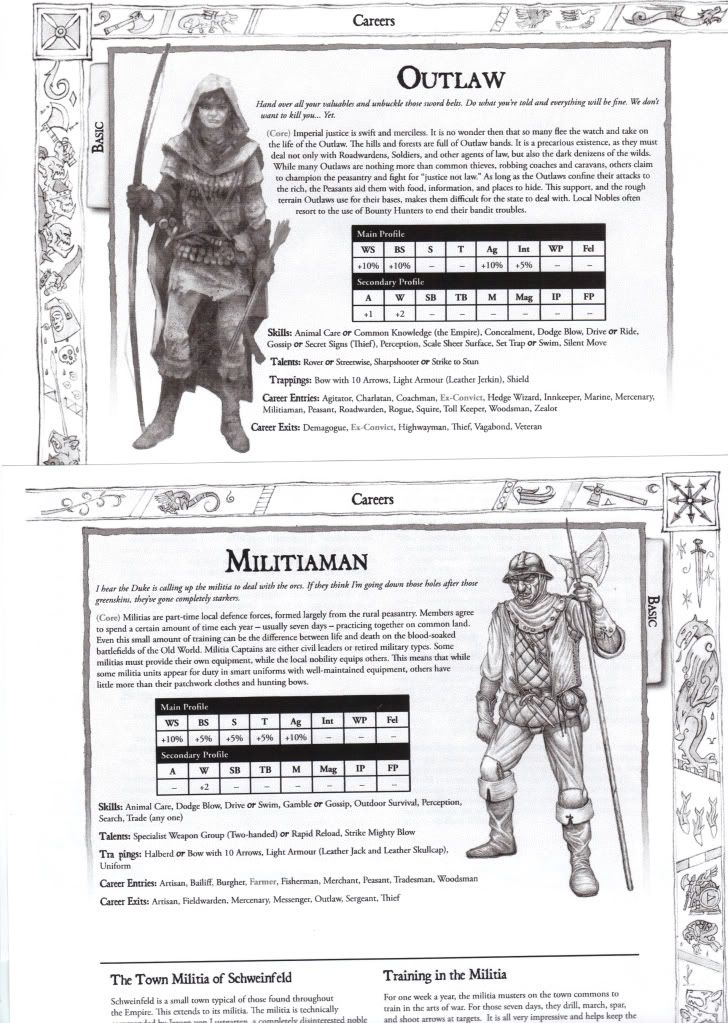
Post: summary of possible Careers and their special rules (work in progress)

Well met, folks, and I'm happy to show you this so you can hopefully put it to use.
This Part 2 or Mordheim Roleplay rules presents players and GMs the ability to turn the Leadership characteristic (a very one-dimensional representation of a character's mental ability) into a series of mental characteristics. The diverse combination of mental characteristics defines the personality of the character, and GMs will be able to use them as a vehicle for storytelling, and also as a roleplay challenge for players.

Mordheim Roleplay part 2 - Personality and Social Interactions (click to download)

In true Mordheim style, who wouldn't wish to see a party of adventurers trying to hold their Dwarf Slayer back from a fight with the Count's guards, and the player controlling the Slayer (who also DOESN'T want to fight the guards!) miserably fails its Self-Control test and all hell breaks loose.

There are seven Mental characteristics that make up a character's personality:
Generosity, Forgiveness, Humility, Self-Control, Free-Spirit, Logic, Willpower.

Personality tests are taken whenever a character would presumably do or say something against their personality. They are 2D6 characteristics tests against the Mental characteristic in question (much like a Leadership test). If the player fails the roll, they cannot help but act according to the character's personality.

Social Exchanges: The rules also show how engage in arguments with NPCs, where players use arguments in order to test the NPC's Mental characteristic most likely to give them a positive result. Depending on the arguments, the Mental characteristic they target and the NPC own Personality, the GM may allow bonuses or penalties. This encourages players to engage in roleplay and real argumentation, which itself feeds the game mechanics.

It should be noted that generating the Personality of a character is something that a players must be comfortable with: this system is meant as a guideline and a roleplay challenge, and no player should be stuck playing a character with a personality they don't enjoy.
I hope you enjoy it, and it can be of use after spending so long in the making.
I certainly cannot claim to have truly come up with this system myself, as it was heavily influenced by the Pendragon Roleplaying Game's Personality system. But to my mind I believe it is a good addition to Mordheim RPG, as it puts fate (once more) in the hands of the dice, much to of the dismay of the players, but also helps brings the characters to life. This has the added benefit of allowing beginners to the roleplay genre to take cues on how to act their character from the Mental characteristics it possesses.

NEXT: expanded Skill lists for different Careers (bussiness skills, social skills, exploration skills, etc).

Roll high and prosper!

Saturday, September 17, 2016

Mordheim RPG part 3- an update: Careers & new skill lists?

Did you think I had forgotten about this?
Aaha, no sir ;)
While I've been trying to wrangle the rules to make sure the system can provide a good "social mechanics" interaction, I came across a resource right there hidden in the game, ripe for the picking: Careers!!

For those who are familiar with Warhammer Fantasy RolePlay (WFRP), each character's advancement is tied to learning the skills and talents of their 'Career'.
A career is anything from a rat-catcher to an acolyte, a burgher, a political agitator, a watchman, a noble or a roguish con-man (but mostly rat-catchers and agitators!). The greatest thing about this system is that is puts players in the lives and professions of their characters, and their life skills (such as they are) is what they have to use to muddle through the politics and social mores of the Old World, while trying to uncover evil plots and make a bit of coin.
Thus, to my mind, WFRP ends up becoming "Sword-and-Sorcery meets Snatch" (the Guy Ritchie movie), with the poor characters (average joes) coming up with all sorts of shenanigans that regular people would have to resolve plots that go way over their heads.


The Mordheim ruleset lends itself very well to this sort of dark humour hilarity, of poorly trained underdogs having at it to the best of their abilities. Mordheim gives us already a wealth of careers we can work with: all the Hero and Henchman stats and special abilities, as well as the skill lists they have access to. Zealots, Ruffians, Petty Thieves, Hucksters, Sewer Jacks, etc.

There are many special abilities from warbands, specific models or Hired Swords, which define very well specific careers and profession, which can be put together into their own skill lists. The several market-associated skills of the Arabyan Merchant and the criminal skills of warbands like the Ostland Bandits and Mobsmen fit very well together into a progression tree or skills with pre-requisites.

Here you can find a thorough list of all model stats and special abilities from GW-released warbands and other warbands that have been created by the Mordheim gaming community. I deliberately left out many of the warband leaders (as their stats are often too high), savage models (orcs, beastmen, skaven) and those associated with lands outside the Empire, as the RPG is intended to, like WFRP, be focused in the lands of men with players following typical professions.

List of Mordheim model stats and special rules (click to download)

I will be creating a re-structured set of skill lists, so any one character with the right choice of skills can eventually become a Merchant, a Warrior-priest or a Thief.
All based on existing Mordheim skills and special abilities.


"But Nuno!" I hear you say, "What's the point of adapting Mordheim to all of this, if I could just play WFRP, where all the rules are made already? Why are you wasting your time?"
And the answer is, first of all I enjoy creating things :) But I don't do it for its own sake: I have a good reason to need this done. Creating something for the sake of it is good Dev training, but is mostly only useful for me, not much for others who may have no need for new rules.
From my ~11 years of experience as a Games Master running things like Dungeons&Dragons and Pathfinder, it's because the rules are too much work. I'm serious: the amount of bookkeeping I'd have to do for Hit Points, and the endless +1 modifiers, for all the NPCs and monsters running around the table, drove me crazy... despite me knowing the rules by heart, and being quite organized. It really tired me out.
WFRP has much of the same amount of detail, especially in combat rules. And it's exactly the combat system that grinds most RPGs to a halt (not all! but most). Don't get me wrong, I like the combat rules, but always felt that the amount of rules detail jarred a lot against the flow of the story... and combat would take hours, even when players are diligent and quick on their rolling.
And is exactly the simplicity of Mordheim stats that appeals to me. 
I've come to believe that to satisfy my thirst for skirmish combat, I have games like Mordheim (where the rules are even simpler and to be honest, more simulationist). On the other hand, if I want a proper RPG story-based experience, I will turn to a less combat-heavy, more skill and social-oriented RPG. Two different experiences for two different needs. 

And I believe that the simple stats system of Mordheim can (surprisingly!) help me run a simpler, streamlined version of a Warhammer RPG, without me having to fuss over a lot of calculations and modifiers and whatnot. And I can create special rules and new NPCs much more easily for it too, instead of having to layer careers on top of careers and racial templates, etc.
Everything is much easier with Mordheim :) And that's exactly what I need, so I'll make it happen.

Sorry this rules-system has been slow to come out, but real-life-work commitments have been eating most of my time (and still are!) and I have other Mordheim-related projects on the go too. It's all coming along, don't worry, these things should take their time. 
Creative work can be a bit tiring from time to time, so having a bit of variety in what you develop is good to keep things fresh and flowing. 
Don't lose hope: projects won't be left to gather dust forever, sometimes you get your best ideas for a project while working on another completely different one!

Roll high and prosper!


Tuesday, November 17, 2015

Mordheim Roleplay part 2: a long awaited dice-rolling party

For those of you who read many months ago that I was "working" on a Roleplay adaptation of Mordheim, and then proceeded to show no progress or news on it for months on end, no one could blame you for thinking this was just wishful thinking of yet another enthusiastic but unproductive gamer fanboy/I-think-I-can-write-rules person.

Well, you are both right and wrong. Perfectionism holds me back from releasing things I've got written down for months, then I leave then still for ages before going back.
The Social Interaction rules for Mordheim Roleplay have been drafted since December 2014, but I haven't finished polishing everything, and other Warhammer/Mordheim projects have shifted my attention from it.
However, I've kept building on it, and realized that before I released the Social Interaction ruleset I actually needed to "convert" how Mordheim plays normally (single tabletop events spaced by post-game phases, strict warband restrictions) to an "adventuring party" system that can harbor a free-flowing story (includding exploration, stealth, searching, etc).
And this document itself sat on my hard drive for some 2-3 months before I finally formatted it and sent it out now.

So I am putting out this first part of the rules, which should get anyone going in running simple Roleplay sessions using the Mordheim system. I know I will. Mind you, everything is still experimental.

Mordheim Roleplay (click here for PDF) 
This will be a live version, which will be continuously updated with time.

I will now be polishing the Social Interaction rules and expanding on skill options that can feed into the Roleplay experience.
Note: at the time of writing, no Social Interaction rules are included, except those for simple Interrogation and Torture (adapted straight from the great 'Traces to Emprise' scenario from Border Town Burning). 
Eventually, The Social Interaction Ruleset will be an add-on, which will replace the Leadership characteristic with a set of Personality characteristics, which hopefully will inject some hilarity and narrative into roleplay sessions.

Sunday, November 9, 2014

Mordheim as a Roleplay Game: part 1

In this series of posts I will be discussing how to harness the Mordheim rules to run an RPG game. First I will discuss its benefits and flexibility (and how they can be applied), and in following posts I will discuss how to adapt rules and elements to flesh out the game for roleplay purposes.
Mordheim has a solid game engine: simple and intuitive stats, logical combat procedure, and easy-to-incorporate special rules. The game is very well-suited to be adapted for a pen-and-paper RPG format.

First, the stats (Characteristics): each is obvious and straightforward, and especially define a models key attributes: WS and BS describe combat ability, while M, S, T, I and Ld define physical and (one) mental attributes. W is the rough equivalent of HP. These define a character quite well for RPG game mechanics.

Initiative sees a lot of use, as it not only determines reaction speed in combat, but is used to evade attacks and hazards, as well as to climb and land safely from falling.
Strength and Toughness may see less varied use, but they are so crucial to survivability that they take a very key role in any adventure. Strength also comes in for purpose of pushing/pulling, and Toughness is used as a health/endurance  defense (against diseases).
Leadership is more complicated though, because it encompasses all of a model's mental attributes, and is slightly too limited for a proper RPG (but I'll come back to it later).
Attacks however is an attribute that specifically only contributes to Close Combat (which it does immensely), but has zero value for anyone who specializes at range. There may be space for development here (I'll get to it later).
Movement is movement, and running is at double speed limiting your ability to shoot (intuitive). The way charging mechanics works does put some strange quirks into combat movement, but these are not too severe. But the fact that jumping and climbing mechanics are fleshed out, together with good movement measurement practices (distance in space as opposed to a square/hex grid) makes fully 3d movement very easy. Because of this, you can play on any terrain surface (even or uneven) and props, with no problem.
Wounds and the Injury table put a nice spin on HP, doing away with larger numerical bookkeeping of damage and putting emphasis on saves that prevent wounds. The injury table also adds a LOT of uncertainty to combat, making it very dangerous and hyping drama. And finally, the game is deadly: it is not that difficult to get knocked out of combat, which increases realism and definitely makes it NOT a good game engine for" heroic fantasy". There is a mitigating factor on the deadliness, which is the Serious Injury table: you only have a certain probability of dying outright after being knocked out, but chances are you will end up with nasty battle wounds and handicaps. There are no resurrection spells, and many risky things (including exploration) can get you hurt. This makes the game engine very suited to gritty dark fantasy settings (which Warhammer is).

In terms of character progression, the Experience and skills system of Mordheim have it covered. By default your upgrades are somewhat random (except in choice of skills), but this could be adapted. But most importantly, it is VERY EASY to generate a new character, making it less of a burden to get back into the game if your character dies. But the randomness helps ensure that a player will not do the same character twice. Another hidden perk of the system is that this ALSO makes it easy for the Games Master to create new NPCs (anyone who has spent hours optimizing an NPC with class levels, in D&D/Pathfinder, know exactly how painful and time-wasting this is).
The skills list offer mostly a choice of combat-oriented abilities (as eexpected but not dissimilar to many other rpgs). Yet there are many skills devoted to movement, and also exploration and relating to purchase of goods. It really only lacks "social" skills, because the game runs otherwise with no role play interaction. But for the most part, existing skills cover everything you'd want.

Mordheim also offers a very good equipment inventory list, and includes already a rarity/availability roll, and skills that interact with it. It is low-magic oriented, so again, well suited to a gritty campaign. The weapons system has a good level of complexity, but their characteristics are well modeled and have a significant effect on a character's combat output and strategy. On top of this, the Hired Swords and henchmen rules provides all costs required for additional recruitment of NPCs into the warband.

The Exploration system of Mordheim is simplified and appropriate for a behind-the-scenes scavenging and resource gathering. However, the exploration mechanics play a large role in the game (especially as a source of income) and have a lot of skill support, so they will always weight significantly in character choices. But good news: the rules mechanics of Exploration dice can very well be adapted to on-the-spot exploration (I will tackle this later on).

Furthermore, the scalability is very good. The game rules power just as easily a regimental army-based game (WHFB) as well as an team skirmish-based game (Mordheim) so scaling up the number of models does not complicate the game too much. Again, this is a boon to Games Masters, as it becomes simple to just throw more enemies at the group without making the fight last forever. Also, the level of threat of multiple enemies increases more realistically, and the characters can be in considerable danger from this (anyone who has tried to stage a combat against many weak enemies, in other RPG games systems, knows how frustrating this situation normally is).
On top of this, because the characteristics system is so intuitive and it is relatively easy to design new special rules, it becomes very flexible for the Games Master to design new creatures and monsters.

So, in summary, the rules are well fleshed out and support most of the aspects required to run an RPG fantasy game. The rules are all there in the internet, for FREE as the product has been discontinued (so distribution between players will NEVER be an issue), and a lot of great material is available online. Check Liber Malefic: these guys produce amazing, professional-quality material, and are responsible (in part) for bringing the much acclaimed "Border Town Burning" supplement for Mordheim.

Watch out for the next part in this series of posts, where I will try to supplement and adapt the Mordheim rules for general everyday RPG use.

UPDATE: The releases about Mordheim RPG can be found in later posts, click HERE